PROLOGUE
Diving In
July 2005
Kachemak Bay, Alaska
We had just loaded several hundred pounds of salmon onto our commercial fishing boat near Homer, Alaska, when I saw another boat drifting toward our beam. I threw the engine into reverse to clear it, but instead of the usual surge, there was a violent, metallic shudder that ran through the soles of my boots, followed by a sudden, hollow silence. After hours of working next to a large diesel engine, that sudden stop is a frightening sound. I knew immediately: the prop had fouled.
Around commercial fishing boats, a loose line in the water is like a snare. When a rope wraps around a spinning propeller, it tightens with such force that the nylon feels like rebar. We managed to use the skiff to push ourselves out of the immediate path of other boats, but we were dead in the water just as the fishing reached its peak. Sockeye were jumping everywhere; even from inside the cabin, I could hear the arrhythmic slap-slap of salmon hitting the surface. We were “in the money,” as they say. A single good day like this can yield as much as two weeks of slow fishing. I couldn’t let that profit slip away.
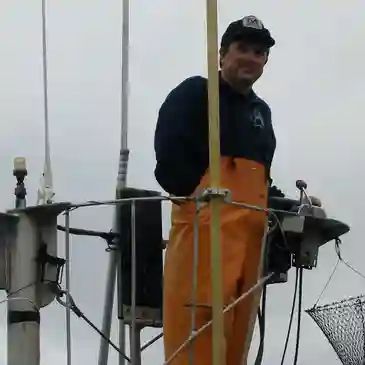
My crew of four on the purse-seine boat included my three children and me: David was 21, Benny was 18, and Sarah was 14. We would spend about two months each summer fishing for salmon in one of Alaska’s most beautiful areas.
“I’m going in,” I said, already kicking off my boots. I planned to jump into that glacier-cold water with nothing more than a steak knife and a swimsuit. I knew the risks: in water that cold, the gasp reflex can seize your chest and flood your lungs before you manage a single stroke.
But we had all been in that water many times. After a long day of fishing, while the summer light in Alaska stretched on all night, we would sometimes use our seine skiff to tow one of us on water skis, much to the bewilderment of the other crews.
I went into the cabin to strip down, but my son David was already there, shirtless and determined.
“I’ve got it, Dad,” he said.
He was an excellent swimmer, but the physics were risky. To reach the prop, he would have to swim under the boat itself. When he ran out of air, he couldn’t just surface; he’d first have to find his way back out from under the aluminum hull before he could ascend.
I tied a safety line around him, trying to hide my shaking hands. Gripping the steak knife, he jumped into the dark and disappeared beneath the boat for what felt like far too long. When he finally surfaced, breathing hard, he confirmed my fear: the wrap was tight.
He dove eight more times. Each time he went under, I held the rope, feeling the faint tugs through the safety line as he sawed at the rope. Finally, he surfaced with a handful of shredded nylon and the bent steak knife clenched in his teeth like a pirate on a sabotage mission.
Sarah turned the diesel stove to its highest setting to help him thaw out. From start to finish, the mini-crisis was over within an hour: the prop was turning again, and salmon were swimming back into our net.
That was how I solved problems: invent a solution, accept the risk, dive in, and fix it without hesitation or delay. I thought that was how all problems were solved.
Years later, sitting in front of an X-ray screen, a doctor pointed at a white blur and handed me a problem that neither courage nor quick thinking could fix. The solutions were no longer in my hands.
CHAPTER 1
Gut Punch
December 2014
Anchorage, Alaska
“You need to get your affairs in order,” the doctor said, his voice heavy with concern. “You have one to three years to live.”
I could hear the strain as he delivered news he wouldn’t wish on anyone. He cleared his throat, fist pressed to his lips, then looked at me before dropping his gaze to the floor. And just like that, my life was upended.
I hadn’t even gone to the doctor for anything serious. It was just my shoulder, an ache that had been hanging around for months. I assumed it was a sprain or maybe something more serious, like a rotator cuff tear. Either way, I thought it was something that could be fixed. Most things were. I ignored the pain until it got so bad I couldn’t lift my instrument at all.
On a typical rehearsal evening with the Symphony or various orchestras in Anchorage, Alaska, I would park on G Street, two or three blocks from the rehearsal hall, and carry my instrument inside. But as the pain got worse, carrying my instrument became unbearable. It didn’t help that I played the heaviest instrument in the orchestra: the tuba.
I finally visited a medical clinic and saw one of the physicians on staff. The clinic was efficient but impersonal, sharp with the smell of disinfectant and the soft trickle of a rock-wall fountain. People stood in line, shuffling forward to explain their ailments to the receptionist. Before meeting her, I told myself my shoulder was just an annoyance, nothing more.
I sat by myself to avoid the coughing and nose blowing, flipping through magazines and thinking about the music I was going to play that evening. Outside, heavy December snow was piling up. The city was being transformed into a clean whiteness that was great to look at but miserable to drive in.
Soon after, an assistant called my name. She walked me through a hallway where I was introduced to the doctor who would be treating me that day, a kind-looking man in his fifties with a short beard and a balding scalp. I explained the pain and weakness in my shoulder. Without hesitation, he sent me to the X-ray room.
After the X-ray, I was asked to wait in a small seating area while he examined the results. The waiting area had three chairs and a small table with outdated magazines. I sat there for 20 minutes, watching other patients walk by and wondering why it was taking so long.
When the doctor finally approached, his head hung low, his face burdened. He invited me into his office and offered me a chair in front of his computer. I recognized the digital picture as an X-ray. My ribcage filled the screen, and near my right shoulder was a large white object. He explained that a baseball-sized tumor was destroying the second rib on my right side, causing pain in my right shoulder. He asked if I had heard of multiple myeloma. I hadn’t, so he spelled it out for me. Then he said, “You need to see an oncologist.”
I later learned this cancer targets plasma cells in the bone marrow, where blood cells are produced. It only affects about 7 out of 100,000 people each year. I was in an exclusive club, one I could do without.
My mind felt numb. I tried to study the X-ray like a music score I’d never seen before. This white mass, where bone should have been, was silently eating through my rib for months while I’d been conducting rehearsals above it. For 32 years, I had been teaching students to read and interpret music notation: black-and-white symbols that transform into sounds that words cannot imitate. Now I was trying to decipher what this white blob meant.
It felt like he was talking about someone else. My voice remained steady as I asked technical questions about tumor behavior, maintaining the same analytical detachment I used to dissect my conductor’s score: breaking it into smaller pieces, trying to solve the puzzle.
For decades, I’d guided teenagers through their first encounters with complex musical ideas. Now I was the confused student, and there were no practice exercises for mortality. You either understand that you’re dying, or you don’t. The doctor watched me with concern, clearly recognizing that I hadn’t truly processed what he’d told me. He seemed more shaken by the diagnosis than I was, at least for now.
I thanked him politely, as if he’d just given me directions to the nearest coffee shop. My body moved on autopilot, shaking his hand, gathering my jacket, and walking through the antiseptic hallways toward the exit. I must have walked through the snow to my car because I found myself standing beside it, keys in hand, wondering how I’d gotten there. An hour earlier, I was a band director with a sore shoulder.